
Tag: Flooding

The Geomorphic Flood Index (GFI) v2.0 is a MATLAB-based toolbox for the rapid and reliable delineation of flood-prone areas, designed with a particular focus on data-scarce environments where detailed hydraulic modelling is not feasible. What’s…

This week we launched the first IAHS Academy course: “Advanced Hydrological Monitoring”, hosted by Eastern Institute of Technology (EIT), Ningbo, China. A strong, highly engaged cohort of students is joining us to work hands-on across key themes in next-generation…

Flood events are among the most destructive natural hazards, requiring comprehensive risk management strategies to mitigate their impact on society and the environment. This study uses the potential of the Random Forest (RF) model to…

This non-exhaustive collection of publications offers a concise overview of the scientific journey of Prof. Mauro Fiorentino — mentor, friend, and scholar who profoundly shaped the evolution of hydrology in Italy. With his original and curious approach,…

In recent years, significant advancements in geomorphic methods have provided a valuable and cost-effective alternative for large-scale flood mapping. The Geomorphic Flood Index (GFI) is one such method that has gained widespread adoption for flood…

Flood events rank among the most destructive natural hazards, necessitating comprehensive risk management strategies to mitigate their impact on society and the environment. Various approaches have been developed to map flood susceptibility. However, current methods…
Flood extent delineation techniques have benefited from the increasing availability of remote sensing imagery, classification techniques and the introduction of geomorphic descriptors derived from Digital Elevation Models (DEM). On the other hand, high-performing Machine Learning…

The IAHS – International Association of Hydrological Sciences is proud to announce dates (July 20-27, 2024) and Venue (Cairo, Egypt) of the first edition of the IAHS Academy, the newly established advanced training and educational programs to advance…
Satellite remote sensing is a highly valuable data source useful in the monitoring of surface water dynamics and an essential tool in flood risk management although several factors can interfere with the detection of water…
This study suggests a rapid methodology to delineate areas prone to flood using machine learning techniques. Based on available historically flooded areas, the model employs and combines globally collectible and reproducible conditioning factors to analyze…
The geomorphic flood index (GFI) method provides a good representation of flood-prone areas. However, the method does not account for floodwater transfers in undefined interbasins (UIBs), which represent intercluded small basins along the coastline likely…
Climate change and landuse transformations have induced an increased flood risk worldwide. These phenomena are impacting dramatically on ordinary life and economy. Research and technology offer new strategy to quantify and predict such phenomena and…
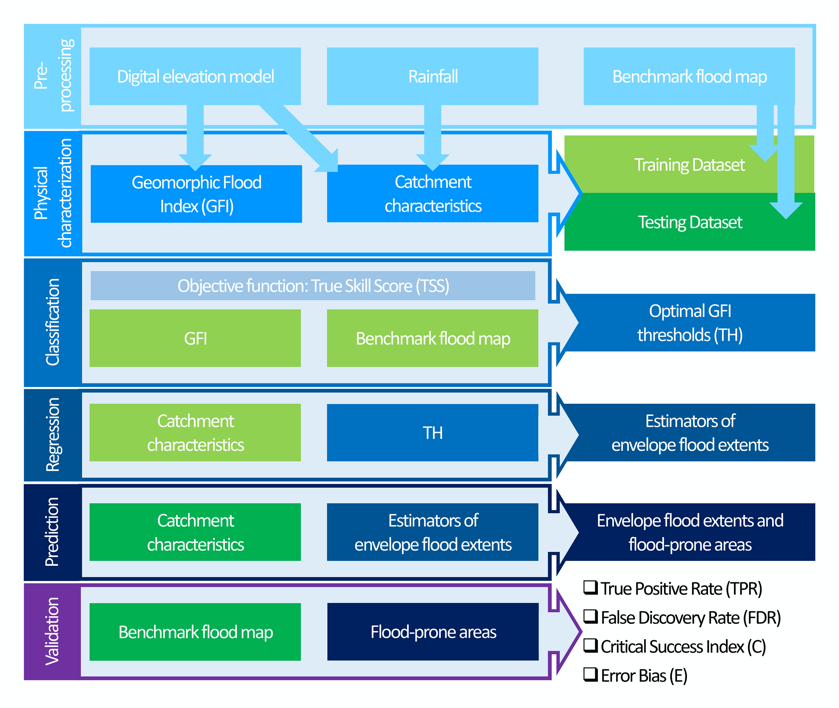
A topographic index (flood descriptor) that combines the scaling of bankfull depth with morphology was shown to describe the tendency of an area to be flooded. However, this approach depends on the quality and availability…
Large-scale flood risk assessment is essential in supporting national and global policies, emergency operations and land-use management. The present study proposes a cost-efficient method for the large-scale mapping of direct economic flood damage in data-scarce…
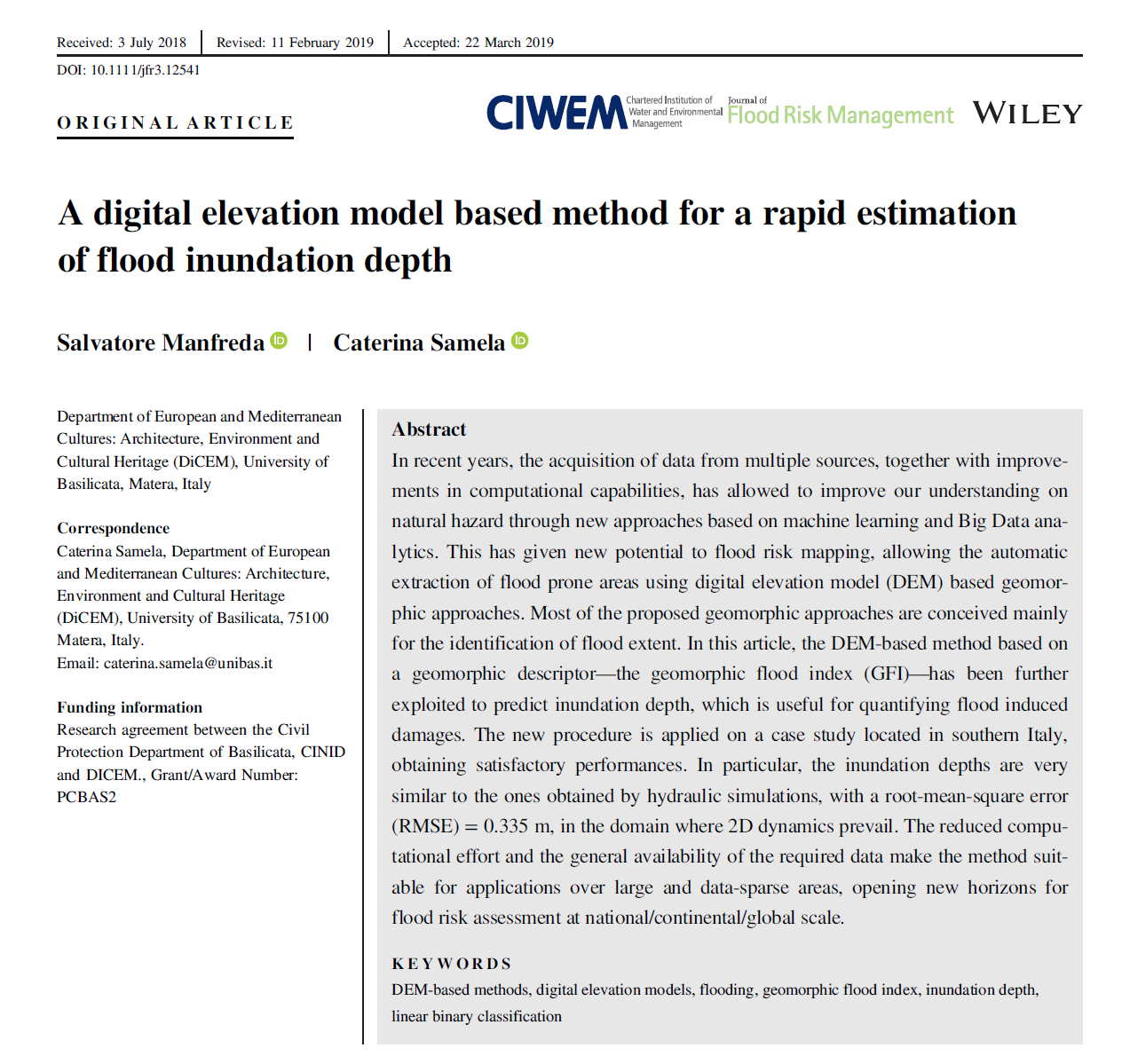
In recent years, the acquisition of data from multiple sources, together with improvements in computational capabilities, has allowed to improve our understanding on natural hazard through new approaches based on machine learning and Big Data…