
Tag: Remote sensing

Satellite-based near-surface (0–2 cm) soil moisture estimates have global coverage, but do not capture variations of soil moisture in the root zone (up to 100 cm depth) and may be biased with respect to ground-based soil moisture measurements. Here, we present…

Estimation of root-zone soil moisture (RZSM) at regional scales is a critical issue in surface hydrology that could be a great help for estimating evapotranspiration, erosion, runoff, and irrigation requirements, etc. A significant number of…
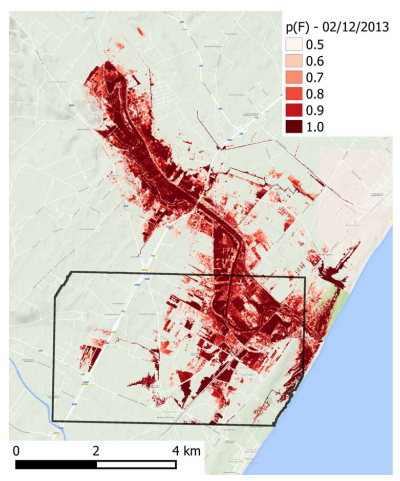
Accurate flood mapping is important for both planning activities during emergencies and as a support for the successive assessment of damaged areas. A valuable information source for such a procedure can be remote sensing synthetic…

In the present work, we developed a new formulation for the estimation of the soil moisture in the root zone based on the measured value of soil moisture at the surface. It was derived from…

Characterizing the dynamics of soil moisture fields is a key issue in hydrology, offering a strategy to improve our understanding of complex climate-soil-vegetation interactions. Apart from in-situ measurements and hydrological models, soil moisture dynamics can…

In the present work, the role played by vegetation parameters, necessary to the hydrological distributed modeling, is investigated focusing on the correct use of remote sensing products for the evaluation of hydrological losses in the…

Savanna grass cover is dynamic and its annual extent resonates with wet season rainfall, as shown by satellite observations of normalized difference vegetation index (NDVI) time series for the Kalahari Transect (KT) in southern Africa.…
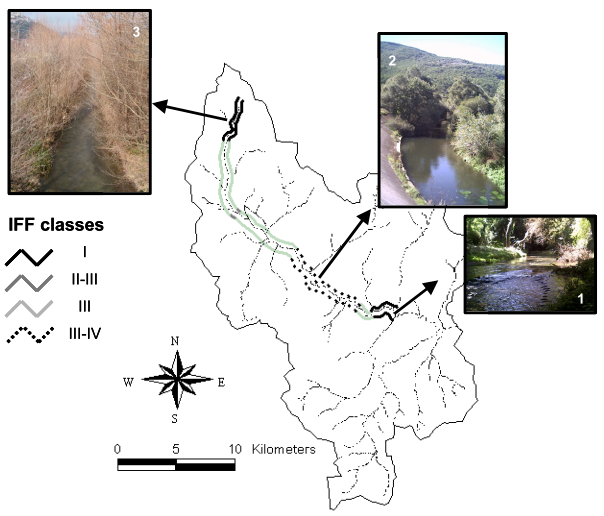
In recent years the need to restore impacted habitats has become a fundamental aspect of environmental management in order to match sustainable development requirements. This is particularly important for fluvial habitats because of their role…

A model devoted to study the ecological restoration of fluvial habitats: a study case, first results
Fluvial habitat represents the most vulnerable ecosystem of the landscape because of its role of environmental corridor. For this reason a correct policy of management of these habitats is strictly necessary. In order to choose…